

Authors of the concept: Davor Ereš and Jelena Mitrović, in cooperation with Peter Laušević and Jovana Petrović
(04–23.05.2026)
Monday, 04. 05. 2026.
17.00 OPENING OF THE EXHIBITION
18.00 BOOK PROMOTION
Plant Space: Territories, Architectures and Technologies of the Vegetal, MIT Press
Participants: Michelle Howard, Adam Hudec (editors) and Davor Ereš
→ BINA KABINA, Mila Milunovića 1, FFA Belgrade
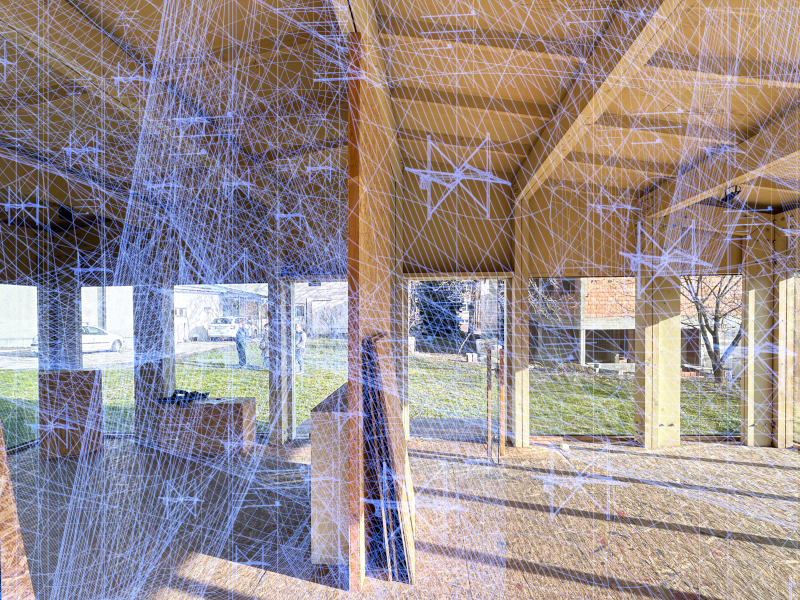
Following the exhibition project Unraveling: New Spaces presented at the Venice Biennale 2025, Unfolding Materiality continues to explore public space through questions of the relationship between materiality, ephemerality, and collective action in architecture. The entire structure will be developed from materials previously used in Venice, following a circular logic in which the wool threads are gradually unfolded into spatial configurations and, by the end of BINA, return to their initial material state, gathered once again into balls of yarn. Through processes of experimentation and material engagement, the project develops a temporary spatial structure that extends into the pavilion space and, through its own process of formation, establishes connections between urban public space and different communities, opening possibilities for new architectural programs.
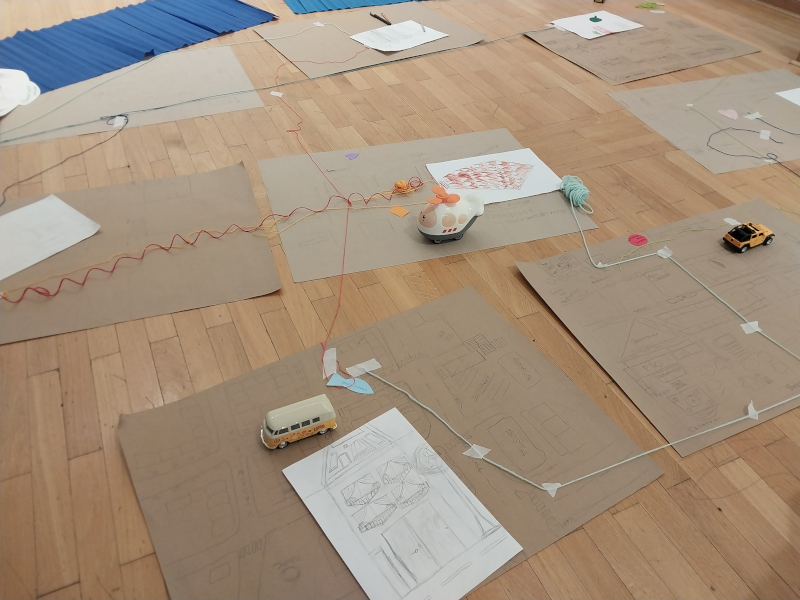
From 29 April to 4 May, the architectural workshop Unfolding Materiality will bring together students and teachers from the Institute for Art and Architecture (IKA) at the Academy of Fine Arts Vienna, the Department of Architecture at the Academy of Fine Arts and Design Bratislava, the Faculty of Construction Management – Architecture at Union Nikola Tesla University, and the Printmaking Department, Faculty of Fine Arts, University of Arts in Belgrade. In collaboration with the project authors, participants will develop the initial spatial structure made of wool threads within the BINA Kabina pavilion, approaching form-making as a process of material experimentation and collective spatial thinking.
On May 4, the pavilion will officially open, presenting a woolen spatial structure that functions as both an exhibition and an ongoing workshop environment. On this occasion, Plant Space: Territories, Architectures and Technologies of the Vegetal, published by MIT Press, will be launched, published by MIT Press as part of a series from the Academy of Fine Arts Vienna. Co-editors Professor Michelle Howard and Dr. Adam Hudec – architects working across art, ecology, and activism – will discuss how the volume rethinks plants as active agents shaping our spaces and knowledge systems. They’ll share the book’s political and social-ecological ambitions, alongside the research and inspirations behind it. A vital conversation on architecture, ecology, and more.
From 5 May to 23 May, the pavilion will function as an open workshop, a space for research, experimentation, and exhibition. The woolen structure will be progressively expanded and intertwined through a series of collective processes unfolding across different workshops, allowing the form to evolve through continuous addition and transformation. Building on processes of learning by doing, the project explores alternative approaches to form-making, materiality, and the temporality of architectural structures through cycles of composition and decomposition.
Within this evolving and continuously transforming framework, the project also seeks to establish connections with the surrounding spaces of nearby schools and the adjacent park by engaging diverse groups of participants, including schoolchildren and participants beyond the professional field of architecture. By inviting them to actively participate in the ongoing construction of the structure, the project aims to articulate and strengthen shared forms of action. Through processes of material practice, both the woolen structure and the process of its collective making will continue to develop and transform throughout the duration of BINA.
The installation unfolds as an open process in which working with wool threads becomes both a method of inquiry and a form of creation. By interlacing and extending threads into spatial configurations, collective action simultaneously generates structure while opening new fields of materiality and spatiality, weaving new connections among participants and the public. The emphasis lies on the collective act of making, through which relationships gradually emerge between materiality, form-making, and circular principles as modes of producing new knowledge. In this sense, Unfolding Materiality evolves through the structure itself, which becomes a site where new forms of publicness can emerge, spaces of encounter, collaboration, and shared material practice through which a new experience of space takes shape.
The project was supported by Reynaers Company.