

Curator of the exhibition: Zoran Abadić, MSc Arch
Authors of the exhibition: Zoran Abadić, MSc Arch and Jelena Bogosavljević, PhD
(30.04–17.05.2026)
Thursday, 30 April 2026
19.00 OPENING OF THE EXHIBITION
→ CCB, Art Gallery, Knez Mihailova 6
Participants: Mihailo Timotijević and Miroslava Petrović Balubdžić; Dejan Miljković, Jovan Mitrović and Branko Pavić; Riste Dobrijević; Slobodan Radovanović, Anica Radosavljević, Uroš Kondić, Katarina Ćirković Vujanac; Srdjan Marlović; Breda Bizjak; Emil Jurcan; Milan Milajković; Milan Đurić and Aleksandra Vuja; Srdjan Tadić; Dinko Peračić and Miranda Veljačić; Vedran Jukić
Not everything is abandoned.
Much of it is simply waiting – somewhat forgotten, yet deeply valuable.
What about architecture that, in its provocativeness, holds the potential to become a spatial framework for events and the initiation of social connections? Careful, nuanced work in the revitalisation of cultural heritage creates the conditions for new circumstances in which society can regenerate, people can reconnect, and architecture can act as a kind of scenographic guide. To uncover specific places, bring them to light, reorganise them, or build anew and adapt them to existing or future uses – these are opportunities that should not be missed in this context.
What matters and is needed is not confined solely to the design and construction of buildings as iconic architectural objects, but also lies in the ordinariness of appropriate small- and large-scale interventions – practical, useful, and beautiful. This is about concrete spaces: architectural representatives within the field of national culture, further defined spatially, programmatically, and beyond time.
The exhibition SHINING uncovered appearances is conceived as an exploration of the distinctive qualities of architectural works by a number of architects, realised in Serbia, Montenegro, and Croatia over the past twenty years. The intention to present and consider, at a single moment, projects of similar thematic and spatial scope stems from the idea of affirming the identified sensibilities and personal affinities of their authors – through which context is distinctly interpreted and valued, and enriched with authentic, highly individual architectural expressions.
Shining, as conveyed through the messages embodied in these projects, is first recognised visually as a form of spatial user experience. It evokes a sense of closeness and understanding of the intervention in relation to its site and the real needs of the society for which it is intended.
At the same time, within a broader environment marked by market saturation – where, in architectural production, quantity often surpasses quality and average solutions rarely lead to excellence – the selected works offer insight into approaches and modes of thinking that extend from the level of concept to the finest detail. These are crucial for establishing relationships and enabling a fundamental level of nonverbal communication.
Although these qualities can undoubtedly be recognised in projects not included in this exhibition, this year’s selection aims to remind us of the conditions under which it was possible to create – or enhance – lasting values, and, subsequently, of the responsibility assumed by society as a whole. This responsibility is reflected in the inherited role of using, maintaining, preserving, and safeguarding these works from oblivion.
Through its display, the exhibition presents a total of fifteen realised architectural works by architects acting as independent authors and/or as part of design teams. Some of the exhibited projects have previously been presented, published, and/or awarded within various events, further confirming their significance and impact, particularly in the field of public architecture.
Thematically, the exhibition can be read as an overview of architectural realisations across two areas: cultural/industrial heritage and public spaces of everyday use.
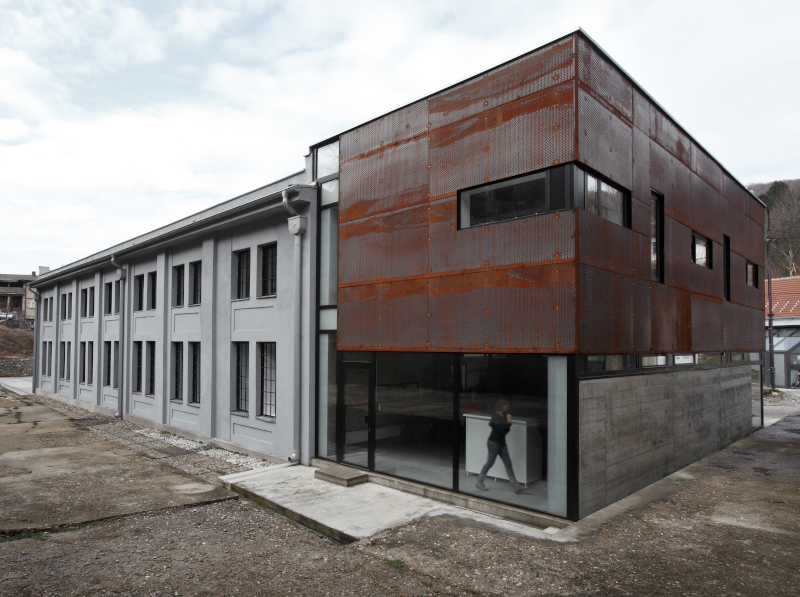
In the field of reconstruction and revitalisation of cultural and industrial heritage, eight projects are presented: City of Miners – Regional Centre of Industrial Heritage (Senjski Rudnik, Serbia, 2014), by Mihailo Timotijević and Miroslava Petrović Balubdžić; Nebojša Tower (Belgrade, Serbia, 2011), by Dejan Miljković, Jovan Mitrović, and Branko Pavić; Hisar Hill Fortress (Prokuplje, Serbia, 2024), by Riste Dobrijević; Fetislam Fortress (Kladovo, Serbia, 2021), by Slobodan Radovanović, Anica Radosavljević, Uroš Kondić, and Katarina Ćirković Vujanac; Venetian Hospital – Austro-Hungarian Barracks (Herceg Novi, Montenegro, 2013) and Forte Mare Fortress (Herceg Novi, Montenegro, 2024), by Srđan Marlović; Underground City (Pula, Croatia, 2021), by Breda Bizjak; and Roman Theatre (Pula, Croatia, 2022), by Emil Jurcan.
In the field of public spaces for everyday use, seven projects are presented: Ambar Macura Warehouse– Zenit 4 (Stari Banovci, Serbia, 2020), by Milan Milajković; International Passenger Pier on the Sava River (Belgrade, Serbia, 2005), by Milan Đurić and Aleksandru Vuja; Gate 25 (Belgrade, Serbia, 2018), by Mihailo Timotijević; Footbridge (Pasarela) (Mojkovac, Montenegro, 2020), by Srđan Tadić; Gruž Market (Dubrovnik, Croatia, 2025) and Benkovac Fair (Benkovačko Selo, Croatia, 2025), by Dinko Peračić and Miranda Veljačić; and Summer Cinema (Biograd na Moru, Croatia, 2023), by Vedran Jukić.
By highlighting carefully executed interventions, as well as their social role and broader impact across different domains of development, the exhibition further foregrounds the cultural, social, and territorially specific needs of particular sites – needs that are only occasionally, and all too rarely, addressed without delay. Ultimately, it is up to us.
Zoran Abadić, M.Arch.