

Curator: Dunja Brkić
(02.04–30.05.2026)
Thursday, 30. 04. 2026
→ Artget Gallery, The Republic Square 5/1
The photography exhibition series „From the Centre“ was launched at the Artget Gallery in 2025 and is conceived as a series of case studies, with the aim of re-examining past photographic practices and the relationship of the Centre and Artget Gallery toward changes and movements on the photographic scene. As a starting point, the series considers photographs held by the Cultural Centre of Belgrade, within the “October Salon” Collection, as well as works donated to the Centre by artists as a token of gratitude for successful collaboration or as an expression of respect for the Centre’s work, alongside acquisitions that the City of Belgrade has entrusted to the Centre for safekeeping.
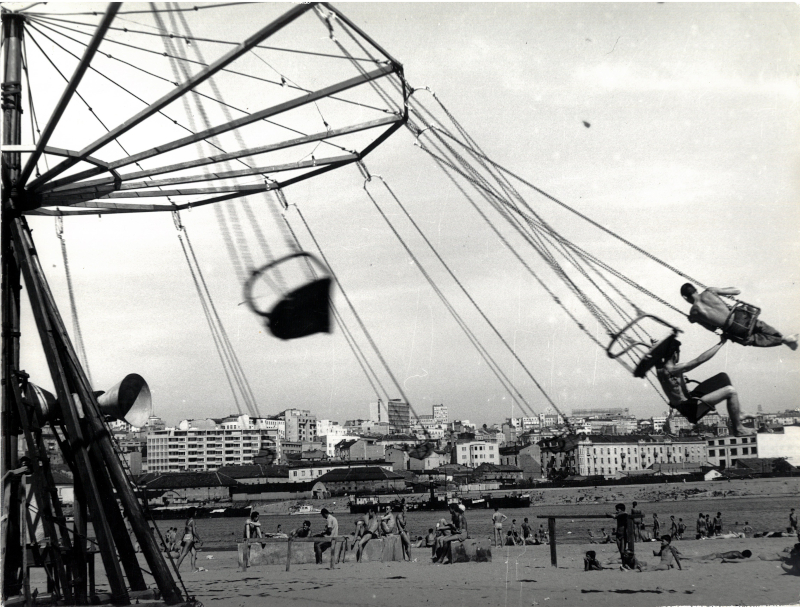
The second exhibition in the “From the Center” series is dedicated to the photographic collection of photographer Raco Bulatović, who in 2007 donated to the Cultural Centre of Belgrade 700 photographs and a registry containing data on nearly 1,720 images. The exhibition is the result of work on the inventory and systematization of this material, within which the construction of New Belgrade emerged as a distinct focus of research. In more than 250 photographs preserved in the Cultural Centre of Belgrade, Bulatović documented the construction of the most important buildings in New Belgrade, from the early 1950s to the late 1970s.
Raco Bulatović’s photographs capture the birth of a new city, marked by the features of modernist architecture and the spirit of a new society and state policy. From sand and marshland rise residential blocks, the buildings of the Central Committee of the League of Communists of Yugoslavia, the Museum of Contemporary Art, the Federal Executive Council, the new Sava Congress Centre, Hotel Jugoslavija, and the Faculty of Dramatic Arts. The photographs were taken in a documentary manner, with the aim of recording change and development; however, from today’s perspective, they also function as a kind of evidentiary material—testimonies in cases of later erasures and transformations of the landscape. Structures such as Hotel Jugoslavija and the Old Sava Bridge were frequent motifs in Bulatović’s photographs, yet they no longer belong to the New Belgrade panorama, so the photographs remain as documents and memories of their former existence.
The meanings and ideas captured in Bulatović’s photographs extend beyond their visual layer. An additional dimension is revealed through the inscriptions, titles, and dates on the back of the photographs, which guide the reading of the scenes and point to elements not immediately visible. These annotations function not only as description or documentation, but also as an interpretative framework that, in certain cases, reveals the author’s perspective while providing a broader temporal and urban context within which the photographs were created. The inscriptions on the back reveal Bulatović’s meticulous tracking of New Belgrade’s development, particularly evident in the example of the construction of the Sava Centre, as well as in cases of unrealized projects, such as the planned Opera House. The omission of the administrative building of the Ikarus factory—despite being mentioned in the notes—serves to underscore the idea of constructing a modernist city on sandy ground, highlighting the deliberation and precision of Bulatović’s compositional choices.
Bulatović’s photographs reveal not only what existed, but also what was planned, omitted, or subsequently disappeared, showing the topography of New Belgrade as an unstable and open structure, subject to constant reshaping. It is precisely in this intertwining of the present and the absent, the realized and the unrealized, the visible and the hidden, that these photographs transcend their documentary function and become a space in which the complex relationship between the city and time is articulated. Viewed from today’s perspective, they testify not only to a single phase in the development of New Belgrade, but also to the transience of every urban form, revealing that every topography, no matter how stable it may seem, is essentially impermanent.