

Cultural Monuments and Archaeological Sites in Serbia. Protection, Education and Sustainability
Guides: Mihailo Timotijević, Miroslava Petrović Balubdžić, Riste Dobrijević
Nedelja, 10.05.2026, from 07.00 to 20.00
→ Ravanica Monastery, Coal Mining Museum_ Regional Center for Industrial Heritage_Senjski rudnik, Pločnik Archaeological Site, Roman Baths, Fortress on Hisar hill
Number of booking places is limited
A visit is planned to the Coal Mining Museum and Fortress on Hisar hill, outstanding examples of interventions on public buildings and public space, shown at the BINA exhibition titled Shining uncovered appearances. On the way to these sites, we will visit several important places in the area that are a part of Serbia’s priceless cultural heritage. We will gain insight into how such diverse and extremely valuable sites are preserved, maintained, how they educate younger generations and how they convey the story of us and our region to other curious visitors.
On this unusual journey through history, we will visit five locations:
Ravanica Monastery (14th century)
Founder: Saint Prince Lazar
In the outstanding historical significance of the Ravanica Monastery, a special place belongs to its Church of the Ascension. In all its elements, it brings something new: in architecture, in the use of decorative plastic and in painting. It is the first monument of a new era in the development of Serbian medieval art: the Moravian school, its most independent creation within the framework of the Byzantine style… www.ravanica.rs
Coal Mining Museum_ Regional Center for Industrial Heritage_Senjski rudnik (2014)
Authors: Mihailo Timotijević, Miroslava Petrović Balubdžić
The buildings are listed as Cultural Monuments of Great Importance, which required a particularly careful and sensitive approach to intervention. The adaptive reuse of the complex as a distinctive open-air museum aims to preserve the authentic character of the oldest industrial complex in Serbia. The concept of restoration and protection of the industrial structures includes preservation, reconstruction, as well as the integration of contemporary architecture and design.
https://muzejugljarstva.rs/
Pločnik (5300/5200-4600 BC)
Pločnik is a site with a rich cultural layer and continuity of settlement, from the very beginnings of the Vinča culture. Since the earliest research, Pločnik has been known in European archaeology for its significant metallurgical content. During earlier research, four hoards were found, with about 50 copper objects. New research has found more copper objects. The repertoire is extremely wide – axes, chisels, needles, bracelets, a piece of copper sheet, and even an ingot (a semi-finished product that is usually prepared for transport and production of objects in another place).
www.narodnimuzej.rs
Roman Baths (3rd-4th century)
The remains of the Roman thermal baths are part of a larger building complex that was once part of the entire settlement. Based on current knowledge, this Roman settlement could only have been located on the route of one of the most important ancient communications, the Viminacium (Kostolac)-Naissus (Niš)-Lissus (Leš). The remains of this ancient settlement, including the discovered remains of the Roman bath, are located in an area where traces of a prehistoric, Eneolithic settlement – Pločnik, which is the most important prehistoric site in this area, have already been found.
https://zzsknis.rs/arheoloska-nalazista-rimske-terme-bace.php
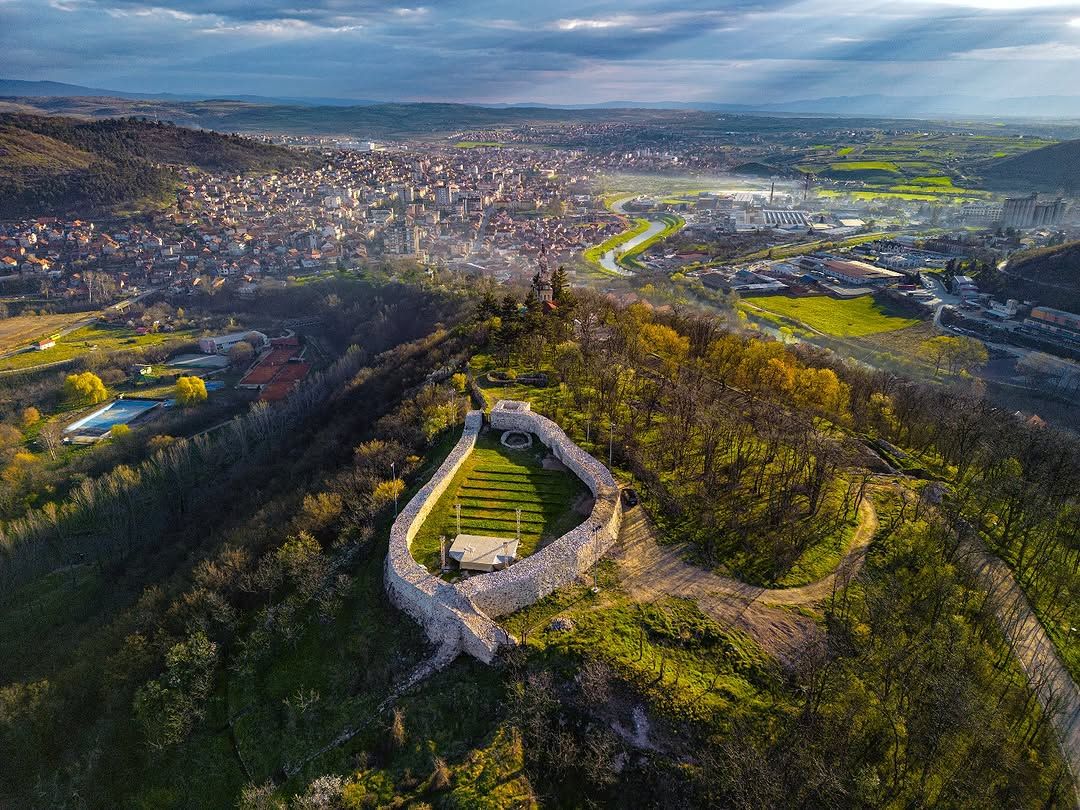
Fortress on Hisar hill _ Revitalization of the citadel plateau (2024)
Summer stage with auditorium
Author: Riste Dobrijević
The entire Hisar hill above Prokuplje is a multi-layered archaeological site with the remains of a fortification that existed from ancient times to the Middle Ages, although there are indications that a much earlier, Bronze Age fortified settlement existed there. Since it was located at the crossroads of extremely important roads, the Roman city of Hammeum (Latin: Hammeum) was first formed around the original castrum on Hisar, and then the early Byzantine city of Komplos. During the Middle Ages, a Serbian fortress with a suburb developed on the same site. Archaeological research indicates that this area was fortified in the second half of the 14th or early 15th century, most likely between 1371 and 1389.
https://tvrdjave.rs/hisar-prokuplje/